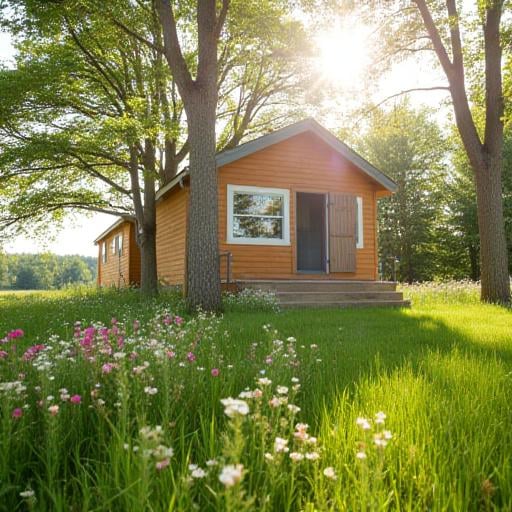
My House Is Too Small. Should I Move or Make It Work?
Selling October 13, 2026
Selling October 13, 2026
Sometimes you don't dislike your house.
You actually really like it.
You like the neighborhood. You know the neighbors. Your mortgage payment is comfortable. You've finally gotten the living room exactly how you want it.
There's just one problem:
You've run out of house.
The kitchen table has become an office. The guest room is also a gym, storage room, and occasional playroom. You're constantly reorganizing closets hoping that somehow you'll discover another 300 square feet hiding behind the winter coats.
Maybe another baby is coming. Maybe your kids are getting bigger. Maybe you started working from home.
Whatever changed, a home that used to fit your life suddenly doesn't.
That's usually when the question starts:
Do we really need to move, or can we make this house work?
Before calling a contractor or putting a for-sale sign in the yard, we'd look at three possibilities.
Stay. Renovate. Move.
And we'd compare more than square footage.
"We need a bigger house" isn't quite specific enough.
What do you actually need?
Another bedroom?
A dedicated office?
A second bathroom?
More storage?
A larger kitchen?
A yard?
A garage?
More separation between everyone living in the house?
Sometimes the problem isn't actually square footage.
It's layout.
A 2,200-square-foot house with poorly used space can feel smaller than a thoughtfully designed 1,700-square-foot home.
Before assuming you need another 1,000 square feet, identify what isn't working about the space you already have.
That answer determines whether staying, renovating, or moving makes the most sense.
Sometimes the least exciting answer is also the smartest one.
You stay.
That might mean:
A few thousand dollars spent thoughtfully can sometimes solve a problem homeowners assumed required a completely different house.
And staying has obvious advantages.
No moving costs.
No selling expenses.
No new mortgage.
No packing your entire life into boxes.
If you have a particularly attractive mortgage rate, staying may be even more compelling.
But we also don't want to spend years trying to solve a problem the house fundamentally cannot solve.
There comes a point where you're not reorganizing anymore.
You're negotiating with the walls.
If you love your location but the house itself isn't working, renovation deserves a serious look.
Maybe you can finish the basement.
Convert attic space.
Reconfigure the main floor.
Add a bedroom.
Build an addition.
Or create the office, primary suite, mudroom, or family space you're missing.
The important question isn't simply:
"Can we renovate?"
It's:
"Does renovating this particular house make financial and practical sense?"
Suppose the renovation you're considering will cost $150,000.
We'd want to understand what your home is worth today, what comparable renovated homes are worth in your neighborhood, and whether the improvement is likely to create value anywhere close to what you're spending.
You don't need every renovation dollar to come back to you.
You're allowed to spend money because something improves your life.
But you should understand when you're making an investment and when you're purchasing a lifestyle improvement.
Those are different decisions.
This is where location starts putting limits on renovation.
Imagine your home is currently worth $450,000.
The largest, most updated homes nearby consistently sell around $550,000.
If you're considering putting $250,000 into a major addition, we need to talk.
You may end up with exactly the house you want.
But you could also end up owning a $700,000 house in a neighborhood where buyers rarely spend $700,000.
That doesn't automatically make the renovation wrong.
If you plan to stay for decades and can comfortably afford it, resale value may not be your biggest priority.
But we want you making that decision intentionally.
Before a major renovation, it's worth understanding the ceiling of the neighborhood, not just the potential of the house.
Sometimes this is the simplest answer.
The house worked beautifully for one version of your life.
It just doesn't work for this one.
Instead of spending $150,000 trying to turn it into something it was never designed to be, you may be able to sell and purchase a home that already has what you're trying to create.
But moving has costs too.
You'll need to consider:
This is especially important for homeowners who purchased or refinanced when mortgage rates were exceptionally low.
Giving up a low rate has a real cost.
We just don't think it should end the conversation before the conversation begins.
This is where we'd put the scenarios next to each other.
Imagine your current home is worth $500,000.
You owe $250,000.
You want another bedroom, a home office, and a larger main living space.
One option is a $175,000 renovation.
Another is selling and buying a $650,000 home that already has those things.
Which is better?
We can't answer that from those numbers alone.
We need to know:
How much equity would you walk away with?
What would the new mortgage look like?
What would financing the renovation cost?
How much value would the renovation add?
How long do you expect to stay?
And perhaps most importantly:
Which house do you actually want to live in when we're done?
Because there's no prize for spending $175,000 transforming a house into something you still don't really want.
There's another cost that's harder to put into a spreadsheet.
How much energy are you spending making this house work?
Maybe five people share one bathroom every morning.
Maybe you work from the dining room and pack your office away every night.
Maybe toys have overtaken every common space because there's nowhere else for them to go.
Maybe you don't invite people over because entertaining feels impossible.
Maybe you're driving 45 minutes every day because the location no longer fits your life.
None of those appear on a mortgage statement.
They're still costs.
Your home is supposed to support your life.
If your life has to constantly rearrange itself around your home, that's information worth paying attention to.
We should also challenge the opposite assumption.
Sometimes homeowners feel cramped and immediately start searching for houses twice the size.
Then they discover what comes with them.
A larger mortgage.
Higher property taxes.
More furniture.
Higher utility bills.
More cleaning.
More maintenance.
More yard.
More things that eventually need replacing.
Maybe you genuinely need significantly more space.
Or maybe what you actually need is better space.
The goal isn't to buy the largest home you can afford.
It's to find the amount and type of home that supports the way you want to live.
Here's the exercise we'd recommend.
What could you change for relatively little money that would make the existing house function better?
What would it cost to create what you're missing, and how much sense does that investment make for this particular property and neighborhood?
What would you likely net from selling, what could you purchase next, and what would the new monthly and long-term financial picture look like?
Then compare all three.
Not just financially.
Compare the life each option gives you.
Outgrowing your home doesn't mean buying it was a mistake.
It may have been exactly the right house for the last five or ten years.
Your life just kept moving.
At SAVIA, we don't think the first question should be:
"How quickly can we sell it?"
We'd rather start with:
"What isn't working anymore, and what's the smartest way to solve it?"
Sometimes that's a renovation.
Sometimes it's reorganizing and staying put.
And sometimes it's realizing you've gotten everything you needed from this home, and it's time for the next one.
The goal isn't to convince you to move.
It's to make sure your home still fits the life you're building.
Stay up to date on the latest real estate trends.

Real Estate Career
Buying

Real Estate Investing
Selling

International Real Estate

Real Estate Career

Buying
Work with SAVIA to receive thoughtful guidance, strategic insight, and a coordinated approach to your real estate goals.